Fueling the Flames
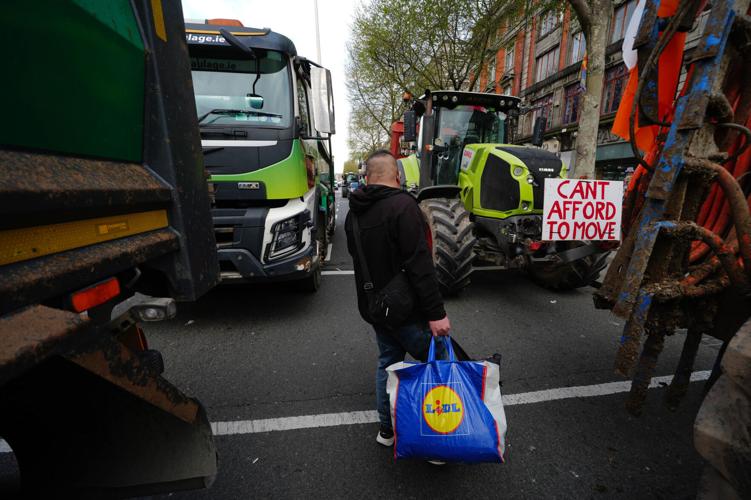
The images have been all over the news this week and last: lorries parked nose-to-tail outside government buildings, farmers blocking depots with tractors, and ordinary motorists honking in solidarity as they crawl past. The fuel protests have returned, and this time they feel different. They don’t feel like a single-issue grumble about diesel prices. They feel like the moment a pressure cooker finally blows its lid.
Because the increase in fuel costs isn’t just another line on the household spreadsheet. It’s another weighty straw on the camel’s back.
I spoke briefly on LMFM last week regarding this. And I generally support the protests, or at least the sentiment behind them. Although I did note that blocking off infrastructure (like the country’s refinery) crosses a line from visible annoyance into problematic obstructionism.
Let’s be honest with ourselves. Irish families have been carrying an enormous load for years now. Inflation has gnawed away at every euro we earn. The price of everything from a loaf of bread to a bag of cement has climbed relentlessly, yet wages have not kept anything like the same pace. Official figures may claim “recovery,” but try telling that to a couple in their late twenties who are both working full-time, paying rent that has doubled in a decade, and still staring at house prices that feel out of touch with their financial reality. All in the context of being told by our government that we have never had it so good.
And then comes the fuel bill.
When the pump clicks past €2 a litre – and it has done so again and again – it isn’t just expensive. It is painful. Because every extra cent at the pump feeds straight into higher food prices, higher delivery charges, higher bus fares, and higher heating costs. Fuel is not a luxury. It is the bloodstream of the entire economy.
What makes the anger sharper is the knowledge that this pain is not inevitable. It is, in large part, policy-made. Successive governments have layered tax on tax – excise, VAT, carbon tax – while simultaneously presiding over spending that would make a lottery winner blush. We have seen reports of eye-watering consultancy fees, vanity projects, and bloated public-sector contracts that achieve little except to move money from taxpayers’ pockets into someone else’s (don’t mention the billions spent on the children’s hospital or transferred into the pockets of the IPAS moguls). Meanwhile, the same ministers lecture us about “shared sacrifice” and the need to “transition” away from fossil fuels.
Transition to what, exactly, when young people cannot even afford the deposit on a modest gaff in a town where they grew up?
That new electric car, the solar panels and heat-pump are a pipe dream for people feeling the squeeze. There is no doubt that diversifying our energy sources would be a good thing, but at the moment a lot of the green options are a very middle class hobby.
The housing crisis deserves its own chapter, but it belongs here too. A generation is being priced out of the property ladder not because they are lazy or entitled, but because their wages buy less and less while the cost of living – led by energy and fuel – spirals upward. When your monthly fuel and energy bill rivals your mortgage payment (if you’re lucky enough to have one), the promise of a better future starts to sound like a cruel joke.
I have spoken to people on both sides of these protests. The truck driver who says he is working longer hours for less take-home pay. The nurse whose shift pattern now costs her €120 a week in petrol just to get to the hospital. The young couple saving frantically for a home but watching their deposit fund shrink every time the price of diesel goes up again. None of them are asking for the unreasonable. They are asking for basic competence from the people we elected to run the country.
The government’s response so far has been the usual mix of temporary rebates, warm words, and finger-pointing at “global factors.” Global factors matter, of course. But global factors did not force us to have one of the highest fuel-tax regimes in Europe. Global factors don’t account for why taxpayer’s money seems to vanish into black holes. Global factors did not create a housing crisis that has failed an entire generation. Global factors did not decide that the answer to every problem is another tax rather than genuine reform of public spending.
The protests, the anger, is not going away because the frustration is not going away. People are tired of being told to “do their bit” while the system that governs them appears to do the opposite. They are tired of watching their real wages stagnate, their children’s futures get more expensive, and their day-to-day costs rise faster than any pay cheque can match.
Fuel prices have simply become the visible spark. The dry tinder underneath has been piling up for years: inflation that hits the essentials hardest, wasteful spending that delivers little value, wages that refuse to catch up, and a housing market that treats young workers like spectators rather than participants.
Until policymakers recognise that ordinary people are not the problem – they are the ones paying for everyone else’s mistakes, and the ones the government should be serving– the flames will keep burning. And the next time the pump price jumps, or the shopping bills, the heating bills we might just see another combustion of that annoyance.
