Dundalk Mobility Hubs: A Step Forward for Sustainable Transport or a Recipe for New Problems?
Dundalk Mobility Hubs
Louth County Council is pressing ahead with its pilot National Mobility Hubs scheme in Dundalk and Blackrock. The initiative aims to improve connectivity and encourage sustainable travel options across the area. I generally welcome the investment of some 11million euro into Dundalk and think that it has some real potential. In Ireland we have only really seen this kind of project in Dublin and Cork to date so it’s something of a coup to get this – but I do have some reservations about being perceived to endorse e-scooters at a council level.
What Are the Proposed Mobility Hubs?
The project involves installing mobility hubs at multiple locations (originally 41, now reduced to 36 following public feedback and councillor concerns). These hubs will provide shared access to e-bikes, e-scooters, and in some cases electric vehicle charging or car-share bays.
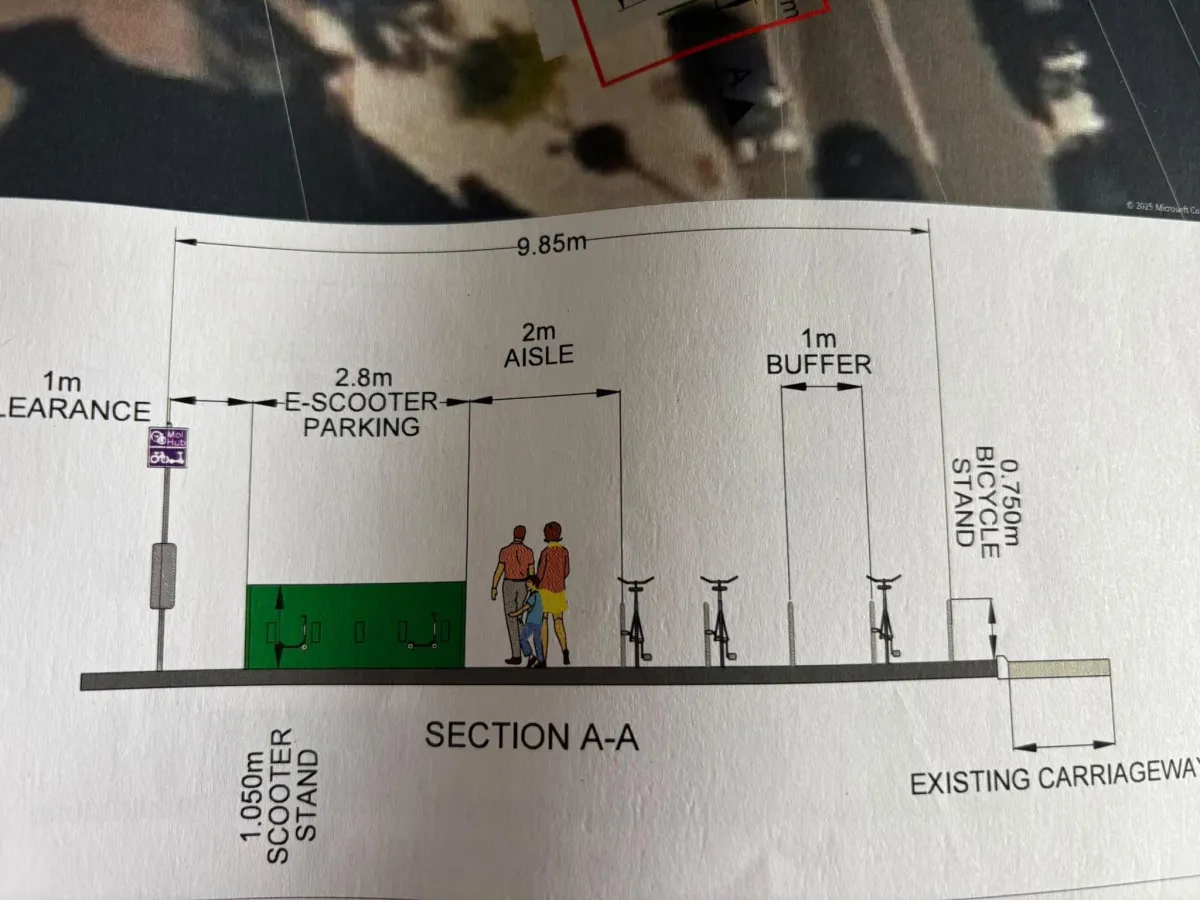
Physical infrastructure includes Sheffield bicycle stands (think Dublin-bikes), dedicated e-scooter parking, information poles, dropped kerbs, and road markings. The goal is to make it easier for residents and visitors to choose active and low-emission travel modes for short journeys, reducing car dependency and supporting better connectivity within the Dundalk Local Area Plan boundary.
The pilot was approved after five locations were removed due to concerns around anti-social behaviour, maintenance, and resident objections. This adjustment shows that public consultation can influence outcomes, though many sites remain.
The E-Scooter Question: Safety Concerns Persist
Despite significant safety worries that I raised, e-scooters will remain part of the mobility hubs offering.
This decision comes after earlier debates I argued e-scooters should be excluded entirely unless guarantees can be given that they will not be used on paths and that there will be robust policing and geo-fencing of the vehicles to prevent this. Their higher speeds and power compared to standard e-bikes have raised legitimate fears about pedestrian safety, pavement use, and potential accidents.
While shared mobility has potential benefits, I have strong reservations about the inclusion of e-scooters without clear, enforceable rules from the outset.
My Reservations: Regulation and Policing Are Essential
E-scooters must be properly regulated and actively policed if they are to avoid becoming a public menace. Without strict controls on where they can be ridden, parked, and who can use them, we risk repeating mistakes seen in other towns and cities.
Pavements are for pedestrians — especially children, the elderly, and those with mobility issues. Unregulated scooter use often leads to dangerous conflicts, abandoned vehicles cluttering public spaces, and reckless riding that endangers others.
We cannot afford to introduce another set of problems while trying to solve existing ones like traffic congestion and emissions.
In the meetings, I also flagged recent motions from other local authorities regarding e-scooters:
In Dublin City Council (August 2025), councillors tabled an emergency motion describing e-scooters as turning streets into "dangerous playgrounds" for reckless riders, with calls for a Garda enforcement blitz, full application of licensing/insurance for high-powered models, and bye-laws banning them from footpaths/pedestrian zones. Cross-party support reflected growing fears for vulnerable users like children and the elderly.
In Cork City Council (February 2026), residents reported feeling "frightened and intimidated" by e-scooters and related vehicles. Councillors discussed rising seizures (e.g., 24 e-scooters in 2025 alone in the city) and urged stronger enforcement via letters to the Taoiseach and Garda Commissioner, noting that official figures likely underrepresent the problem.
In Kildare County Council (February 2026), a motion described e-scooters as a "menace," with councillors highlighting reckless use, speed limit breaches, and increasing fatalities/near-misses among youths. The council agreed to write to the Minister for Transport seeking better enforcement and regulation.
In Tipperary County Council (January 2026), a councillor proposed mandatory high-visibility jackets for riders after witnessing multiple "near-misses," prompting the council to lobby the Minister accordingly.
I finished by saying that I hoped that this pilot would be robust and humble enough to admit if the scooters were proving a problem. That we would at least be able to reel back if there were complaints form the public that they were dangerous. On that note at least, the director and consultancy firm we are working with, were positive and said that it was a pilot and that it could be reviewed. On these grounds, given we effectively had a ‘use it or loose it’ offer of the money, I was willing to support the hubs.
Avoiding Hypocrisy After the Scrambler Campaign
This brings me to an important point of consistency. Many in our community, including through local information campaigns, worked hard to highlight the dangers of scramblers and quad bikes in public places. We rightly called for stronger enforcement against illegal and anti-social use of these vehicles on roads, paths, and green areas.
Scooters are less powerful than scramblers, and they will need an account (and therefore some sort of attached ID and accountability to use). This is a positive at least as it would be hypocritical to now turn a blind eye to potential issues with e-scooters simply because they come under a "green" or "sustainable" label.
We need the same level of vigilance and enforcement here as we demanded for scramblers.
Moving Forward Responsibly
The mobility hubs concept has merit if implemented thoughtfully. Promoting e-bikes and better active travel infrastructure can genuinely help reduce car use for short trips and improve health and air quality.
However, success will depend on:
Clear regulations on e-scooter operation (speed limits, no pavement riding, designated parking only)
Visible and consistent policing/enforcement
Ongoing monitoring and quick response to misuse
Proper maintenance of the hubs themselves
Continued community engagement to address concerns
I urged, and continue to urge, Louth County Council to treat e-scooter integration with the seriousness it deserves and put robust safeguards in place before the pilot launches fully.
Sustainable transport should enhance our towns, not create new headaches for residents. With the right rules and enforcement, these hubs could be a positive addition. Without them, we may simply be trading one set of problems for another.
A list of the locations are below.
